
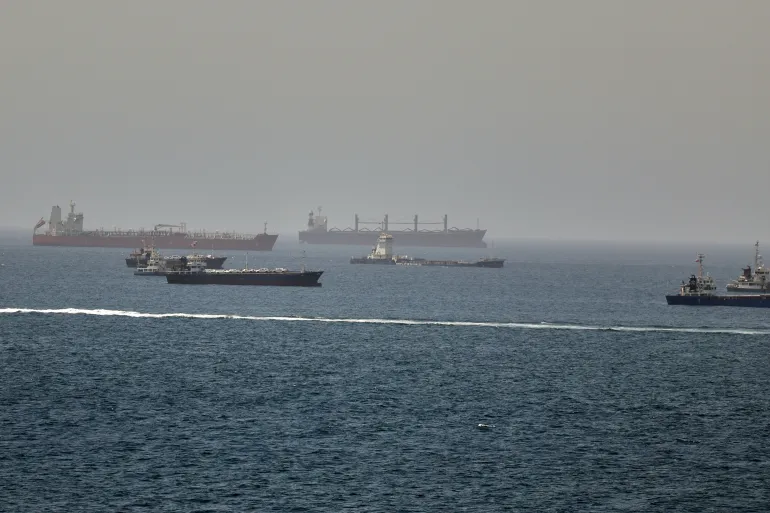
Trump Declares the Strait of Hormuz Part of U.S. Territories as Tehran Sets Conditions for Reopening the Strait
Al-Taj News – U.S. President Donald Trump posted a map of U.S. territories on the Truth Social platform, adding the Strait of Hormuz to it, while Tehran announced that it is preparing a list of conditions for reopening the strait in response to a request from mediators.
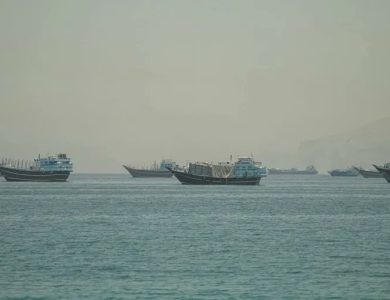
On his account on the Truth Social platform, Trump added the word “New” next to an image of the strait, implying that it had recently come under U.S. authority.
Ten days earlier, the U.S. president had posted a map of the Strait of Hormuz on Truth Social titled “New American Land,” which prompted an Iranian response at the time.
Trump had previously stated from the White House that the strait is open and under full U.S. control, stressing his country’s outright rejection of holding any talks with Tehran, which he claimed was suffering from economic collapse, the destruction of its military capabilities, and difficulties in paying the salaries of its soldiers.
On the ground, Commander of U.S. Central Command (CENTCOM) Brad Cooper announced that approximately 50,000 U.S. troops, backed by more than 20 warships and hundreds of aircraft, continue to carry out their mission to impose a naval blockade on Iranian ports, preventing any vessel from entering or leaving without prior permission, except in humanitarian cases.
Cooper explained that U.S. forces had successfully cleared the international shipping lanes in the strait of mines planted by Iran’s Islamic Revolutionary Guard Corps, and secured the passage of around 1,500 commercial vessels, while turning back 75 vessels that attempted to breach the blockade and disabling three vessels that failed to comply with orders.
In contrast, Iranian Secretary of the Supreme National Security Council Mohsen Rezaei confirmed that Tehran is preparing a list of conditions for reopening the strait in response to a request from mediators, noting that ending the war in the region is at the top of the list.
Rezaei revealed understandings with the Sultanate of Oman to establish a shipping corridor passing through the territorial waters of both countries, through which vessels could transit if Washington responds to the conditions. Meanwhile, the Islamic Revolutionary Guard Corps conditioned the reopening of the strait on lifting the blockade of Iranian ports, paying compensation, and canceling the sanctions.
These developments coincide with active diplomatic efforts, as Qatari Prime Minister and Foreign Minister Sheikh Mohammed bin Abdulrahman Al Thani met Thursday with senior Iranian officials in Tehran, stressing during the talks the importance of respecting freedom of navigation in the Strait of Hormuz in accordance with international law, in an attempt to revive the path of de-escalation and previously concluded understandings.
The crisis that erupted in late February led to a sharp decline in maritime traffic through the strait, which had served as a passage for around 20% of global oil and liquefied natural gas supplies.
Estimates from vessel-tracking services indicate that maritime traffic has fallen to between 5% and 15% of normal levels, while the International Maritime Organization, a United Nations agency, documented 70 incidents in the strait that resulted in the deaths of 19 sailors.